Liquefied Reality: How the Corporate Civilization is Boiling the Human Soul
Imagine, if you will, playing a game of chess where with every move you make, the very dimensions of the board shift and warp beneath your pieces. The rules are not just broken; they are continuously rewritten by the observer. You cannot plan, you cannot strategize, and inevitably, the game collapses into absolute chaos.
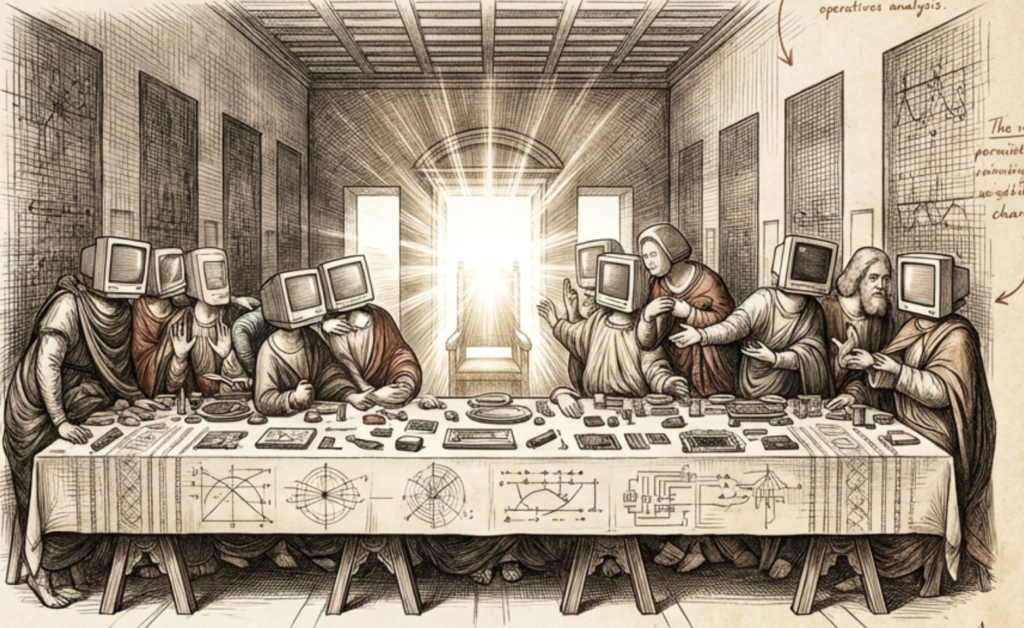
This is not a mere thought experiment. According to the Principles of Biological Natural Philosophy, this is the precise operational mechanic of modern human civilization.
We are living in a society that has unmoored itself from its fundamental anchor, and we are paying the thermodynamic price.
The Sacred Anchor: God ≌ c
To understand this paradigm shift, we must first look to physics. In the physical universe, the speed of light (c) is not merely a high velocity; it is the absolute limit, the bedrock upon which causality itself rests. Without this unbreakable constant, the sequence of cause and effect shatters. You might see a glass shatter before it hits the ground. Time and space would lose their structural integrity.
Furthermore, according to Gödel’s incompleteness theorems, C is an anchor point outside the system; a system must rely on external evidence to know itself. This relates to the function of God within human society. This is based on the isomorphism of physical topology.
The core axiom of our theory applies this physical necessity to human society: God ≌ c.
In this context, “God” is not a religious figurehead, but the societal equivalent of the speed of light—a sacred, immutable constant. It represents non-negotiable values: the sanctity of life, the definition of family, the bedrock of justice. When a civilization is anchored to such a constant, it operates as System B (The Biological Civilization).
System B is like a crystal. The atoms (individuals) are locked into position by powerful chemical bonds (tradition, faith, infinite responsibility). It may feel rigid, even restrictive, but it is incredibly stable. It can bear immense weight without breaking.
The Phase Transition: Melting the Crystal
However, the modern era—which we define as System A (The Corporate Civilization)—decided that these rigid boundaries were too confining. We craved the “freedom” of a universe without an absolute speed limit.
But when you remove the absolute constant, society does not simply remain the same but faster. It undergoes a literal phase transition. The solid crystal melts into a liquid.
Without a sacred anchor to hold values in place, society experiences a sociological equivalent of length contraction from relativity. Morality becomes entirely relative. The bedrock structures of love, justice, and human life are liquefied into tradable commodities.
In System A, there is no bottom line. Everything has a price tag; everything has an exchange rate.
This creates a terrifying reality. When every interaction must be calculated and negotiated from scratch, it requires an immense expenditure of energy. It breeds exponential entropy—chaos—within the system.
The Illusion of Universal Values
One might argue that modern society still holds sacred values. We speak endlessly of human rights, human dignity, and international law. Do these not serve as our anchors?
The physics-based diagnosis of our theory is brutal: These “universal values” are stolen goods.
During the Enlightenment, philosophers and state-builders essentially stripped the assets of theology. They kept the beautiful conclusions—that human life is sacred, that all possess equal dignity—but they discarded the foundational premise that made those conclusions logically viable: the Sacred Anchor. They kept the flower but severed the root.
Now, we are running on borrowed momentum. We possess the facade of a solid moral foundation, but underneath, there is a void. Without a physical, absolute anchor, these values are hollow. They are corpses on display.
Because they are hollow, they are highly malleable. You can use the rhetoric of human rights to justify dropping cruise missiles on foreign cities. You can use “freedom” to justify extreme economic exploitation. The language sounds like System B, but the operational mechanism is the pure liquidity of System A.
The Trinity of the Phase Transition
How did we physically transition from the solid state of System B to the high-entropy liquid of System A? It was not overnight. It required a specific sequence of events—a Trinity of Phase Transition.
- The Step-Down Transformer (Cardinal Richelieu): In 17th-century France, Richelieu invented the concept of Raison d’État (Reason of State). As a Catholic Cardinal, he should have been anchored to System B. Yet, he funded Protestant armies against Catholic ones purely for France’s geopolitical gain. He uncoupled absolute personal morality from the responsibilities of the state, lowering the “moral voltage” so that larger, more ruthless machines could be built.
- The Adiabatic Shield (The East India Company): The invention of Limited Liability was akin to short-circuiting Newton’s Third Law (every action has an equal and opposite reaction). Limited liability created an impenetrable shield around shareholders. They could exert massive destructive force across the globe—funding colonialism, plundering resources—while the consequences were violently deflected away from them. The instigators of the force bore no consequences.
- Severing the Vertical Link (The Guillotine): The execution of the French King was the physical manifestation of severing the connection to the Absolute Constant. Historically, the monarch represented the nexus between the divine order and the earthly realm. By severing that tie, society was atomized. The interconnected, organized population of System B was chopped up into isolated, legally equal gas molecules, bouncing around in a void without a center of gravity.
The Engines of Combustion: Total War and the Cold War
Once the crystal was melted and boiled into a gas, how did this high-entropy System A operate? Through extreme pressure and combustion.
Total War (pioneered by General Ludendorff in WWI) turned the entire nation into a single thermodynamic engine. The old boundaries between civilian and soldier were erased. Humanity was liquefied into pure caloric fuel to keep the state machine running.
The Cold War can be viewed not as an ideological battle between good and evil, but as a massive, malicious corporate merger between two System A giants (US Corp and USSR Inc.). Both had entirely decoupled from the Absolute Constant, seeking only to maximize their market share of global influence through different economic algorithms.
The Soviet system ultimately failed not because of a grand moral awakening, but due to fundamental thermodynamic inefficiency. A centrally planned economy attempting to process millions of variables through a single bureaucratic bottleneck created massive internal friction. The system literally choked on its own entropy and overheated.
The Trolley Problem: The Cowardice of System A
To understand how deeply this liquid logic permeates our lives, consider the famous Trolley Problem. It is constantly framed as the ultimate test of ethics.
But our theory re-frames it entirely: The Trolley Problem is not a timeless ethical dilemma; it is the highly specific symptom of a society obsessed with Limited Liability.
A true System B sovereign, anchored to a sacred constant, would not experience the paralyzing dilemma of the trolley. They possess the absolute authority to sacrifice one to save five, but crucially, they also bear the infinite, crushing moral responsibility for taking that life. They carry the burden of the blood spilled.
In System A, no one wants that burden. We want the profit of saving five, but we are terrified of the moral liability of killing one. We want a perfect mathematical algorithm that absolves us of guilt by declaring pulling the lever the objectively correct choice.
The Trolley Problem is an excuse for a system that wants to play God without taking on the liability of one.
The Paradox of Education: Precision Grinding
This brings us to one of the most counter-intuitive observations of our time: The highly educated often experience skyrocketing levels of anxiety (high internal entropy), while those with less formal education frequently report feeling happier and more grounded.
If education is the ultimate tool of progress, why does it make us run so hot?
In System A, modern education is an industrial process. It takes raw humanity and precision-grinds away all the biological, traditional rough edges, turning them into a perfectly smooth, frictionless component that can slide seamlessly into the corporate machine.
But in doing so, it ruthlessly severs their natural antennas connecting them to the Absolute Constant. It isolates them from the natural world, deep family ties, and faith.
Those uneducated within this framework are raw ore. They remain directly anchored to basic biological meanings: eating, loving, raising children, working the earth. They are still operating in System B. Their internal systems run cool and stable.
The highly educated, floating in a frictionless void, constantly overheat as their brains burn massive amounts of energy trying to artificially calculate their own meaning, because the rules keep changing. We have to recalculate our morality and purpose every single morning.
The Thermodynamic Reckoning
We are pushing the fluid logic of System A to its absolute physical limits, burning massive amounts of energy, barreling toward a total thermodynamic collapse. The underlying laws of thermodynamics do not care about our political preferences. A physical system without an absolute constant cannot sustain itself indefinitely.
This leaves us with a provocative thought: If the current global System A eventually burns through its fuel and collapses, can we artificially engineer a new, universally accepted Constant (c) before hitting the breaking point? Or does physics demand that the current system must burn out completely, hit rock bottom, and dissipate its heat before a new, stable, solid-state System B can rise from the ashes?
We like to think of our daily reality, our values, and our society as solid. We think it’s firm ground. But without a constant to anchor us, you might just realize we are already liquid, slipping right through our own fingers.
This is the kind of thinking that 007 Red’s Ontology of Light, Volume 2, Corporate Civilization, brings to our readers.
Welcome to The Light Ontology.
Tune into our frequency. Bypass the academic filters and download the raw,
uncompromising source code of the universe.